Saturday, February 23, 2019

Gaslight much?

Gaslight: 
Verb: manipulate (someone) by psychological means into questioning their own sanity. 
"In the first episode of her life, Jane is gaslighted by her former husband." 

I used to call it the Jedi mind trick. The idea that a person can just say something with such resolve that it must be true—say with such certainty that obviously I’m somehow crazy.  
I still have a really hard time if I feel someone is trying to gaslight me. I think it’s probably one of the biggest things in my life that I get really defensive about. Sometimes it’s hard to know if someone is just mistaken about what just happened or if they are trying to manipulate me. Either way, I don’t like the feeling that my memory is completely wrong.  
There is new documentary on Netflix right now called “Abducted in Plain Sight.” It’s truly shocking and will probably make you rethink people in your own life or past. The true story in the documentary shows the extremes of manipulation—a man works for years through a series of lies and manipulation to get into a family and control the parents with shame and guilt in order to take their young daughter away to be his lover. Yeah, it’s creepy as hell. 


I think the response I hear the most from people who watched this documentary, is “how in the hell do you let someone do that to your family?” I’m sure that’s the question this family will now have to endure for the rest of their lives.  
But really, how does that happen?  
If you’ve ever had to live with someone in your life who is a sociopath (Defined as: ‘a person with a personality disorder manifesting itself in extreme antisocial attitudes and behavior and a lack of conscience) then you know that something as crazy as this movie can happen to anyone.  
And the question, “How did you not know?” becomes a popular question among friends when you finally tell your truth. 
I think the question comes from what most of us feel when we see a movie like “Abducted in Plain Sight,” is simply, “Could this ever happen to me?” 
If you know my story, then you know I spent almost 17 years of my life with someone that I would now refer to as a sociopath. It took me many years to understand that he was a sociopath and what that term actually means. If you know me, then you also know, I’m smart. So, if you think intelligence will protect you, then you underestimate the power of a sociopath. 
For instance, some characteristics of a sociopath include: Superficial charm and good intelligence; absence of delusions and other signs of irrational thinking; absence of nervousness or neurotic manifestations; unreliability; untruthfulness and insincerity; lack of remorse and shame; inadequately motivated antisocial behavior; poor judgment and failure to learn by experience; pathologic egocentricity and incapacity for love; general poverty in major affective reactions; specific loss of insight; unresponsiveness in general interpersonal relations; fantastic and uninviting behavior with alcohol and sometimes without; suicide threats rarely carried out; sex life impersonal, trivial, and poorly integrated; failure to follow any life plan. 
But I think the most important thing to know about sociopaths is that the traits they seek out in people to take advantage of are the same traits most of us already have--which is why we have to realize that it really can happen to anyone. Your life could be the next trending Netflix documentary.  
Why? Because we all make mistakes. I know in my personal life I did things that I am not proud of and those are the points in your life that a sociopath can use to control you. And that’s how it begins--and from there, it’s just a matter of time before you’re down that rabbit hole and people are asking you the question--how did you not know? 
And the only truthful answer I can give is that a part of me did know but the bigger part of me, the part that I wanted to believe, did not truly acknowledge or even have the power to acknowledge what was really going on in my life. 
I think the best gift I got out of what happened to me many years ago is the gift of knowing that even if you’re a smart, good, loving person, bad things can happen to you. You can end up broke, you can end up with your kids in therapy, you can end up alone, you can end up on food stamps and government healthcare, you can end up in debt, you can end up getting behind on bills, your house can go into foreclosure, you can be publicly humiliated, you can feel like the biggest failure on the planet. 
And why would that be a gift? Because in the end, there is always going to be a part of us that can be abducted in plain sight—for some of us it’s our trust, our marriage, our belief in other people, our faith. For others, it’s their dignity, their family, their home, their money.  And when that end happens, people are going to ask, “how did you not know?”  
I didn’t know. Even though the truth was right there in plain sight, I just didn’t see it. I beat up myself for it. I was embarrassed. I replayed moments over and over in my mind. I’ve seen my friends do the same thing in their own lives—wondering how they allowed someone they cared for to trick them, lie to them, gaslight them.  
It’s OK. Bad things are going to happen to you in plain sight, it’s how you handle it inside yourself that matters in the end.  
I have a friend who is going through a divorce right now and the part I think that seems to bother her the most is that she feels she wasted 20 years of her life with a person that she knew didn’t really love her or respect her. And my response to her is to just forget that part—focus on the now. Focus on what you can control and focus on where you want to go.  
Don’t waste your time beating yourself up or feeling like an idiot or feeling like you have to answer questions about how you didn’t really know. Because in the end, it doesn’t matter what happened. Telling yourself that you are stupid is just a way to gaslight yourself. And why do any of us need anyone else gaslighting us? 


Sunday, January 6, 2019

At a crossroad


Definition of crossroad
1: a road that crosses a main road or runs cross-country between main roads
2: usually crossroads\ˈkrȯs-​ˌrōdz also -​ˈrōdz
a: the place of intersection of two or more roads
b: a small community located at such a crossroads : a central meeting place
c : a crucial point especially where a decision must be made 
***
A long time ago—back when I only had one child and I was married to someone else, I came to a place in my life most people would call a crossroad. It was about 16 years ago. I was moving from Columbus, Ga. to Savannah, Ga. My daughter was about 2 years old and I’d been married about 6 years. I was an Army wife living that Army life--that’s the reason we were moving again.

I didn’t really know anything about Savannah but apparently that was a good career move for the Army at the time so that’s where we went. While he was busy doing career stuff, it seemed the best for me to drive out to the new house and get there a few days before the movers were supposed to show up while he finished tying up loose ends at work.

The night before I left Columbus, I looked over the map to make sure I knew the best way to get across the state. Columbus is on west side of the state—just touching the Alabama border. Savannah is almost touching the Atlantic Ocean. I would need to make my way through some rural areas and small towns to get to I-16 which would lead me all the way to Savannah.

I would know I was close to where I needed to go when I hit I-95. I traced my fingers along the route and hovered over I-95 for a while. I-95 goes north to south—if I took it north, I could take it all the way to Boston. That would be a little more than 1,000 miles away from where I supposed to go. The idea of going somewhere else, somewhere secret, was the first time I was a little excited about the move.
What if I just got on I-95 and went north and kept driving until I couldn’t drive any farther? It would be days before anyone would realize I didn’t make it Savannah and who would ever guess I would leave like that—of course I would tell my sister about the plan once I made it but no one else would know. No one in Boston would know me and I could just blend in and start a new life.

At the time, I’m not really sure if I knew how miserable and lonely I was. Thinking back, I know I wasn’t very social at the time despite living in a housing area on Ft. Benning that was a cluster of row houses linked together in a circle with a large playground in the middle of that circle. You could walk out your back door everyday and see just about everyone you were supposed to know and hang out with. It was an instant play date just about any hour of the day and for stay-at-home moms, that may sound like the perfect place to live.

But I felt watched and judged and I mostly stayed to myself. My daughter had major surgery to reconstruct her hips and legs and spent most of her time there in a body cast. Going outside in the circle meant I had to endure the sad looks and the constant, “let me know if I can do anything…” I had a few friends who “got it” but it was hard to really be consistent in my social time especially with all the doctor’s appointments and therapy and the feeling that I just really didn’t belong anywhere.

But Boston, that could be the answer. That could be the change I needed. A new start.


I went to bed that night envisioning driving to Boston. Thinking about how much money I could pull out in cash to live off until I could find another way to make money. How long would it be before anyone knew? How long until my husband realized I was gone? He’d probably be a little relieved in the end to finally just be done with it all so he could go on to the do the things that seemed to make him happier than being stuck at home with us.

He had already gone to work that morning by the time I loaded everything in my Jeep and pulled out of the circle for the final time. I drove out the front gates of Ft. Benning with the plan to head to Savannah. I looked in the rearview mirror to see my daughter in her car seat. Her baby doll wrapped in her arms and a smile on her face.

Looking back on that year in Ft. Benning, it’s no surprise I was unhappy. My husband had decided that he would spend every day working on his boxing in hopes he could join the Army boxing team or somehow go pro. It meant going to the boxing gym downtown every night, no matter what. I needed help at home but on the nights I insisted he stay home and help, he made everything so miserable I would eventually just say, “you know, I’m fine. Really, go ahead and go to the gym.” Even after my daughter’s major surgery in Atlanta, he had his mind set on getting back to Columbus that day so he would work out—despite my gut instinct and the nurses’ advice, we packed up my daughter and took her back home even though her oxygen levels were very low.

Leaving to drive north on I-95 seemed to be the best way out. If I told him I was unhappy, it would have been a fight. If I said I didn’t want to move to a small city with no children’s hospital, it would have been a fight. I could make it work, I always had. And besides, you don’t just walk away.

Between the stops for diaper changes and food, I hit I-95 almost 6 hours after I left Columbus. The signs started popping up about nine miles away from the turn. My heart was beating faster and faster as I got closer to the exit. I kept looking at the rearview mirror wondering what my daughter would think of me one day knowing I had taken her away on my own to live in some unknown place. I almost laughed at the absurdity of the plan. The only thing that kept me wanting to make that exit was the thought that somehow leaving might make him realize I didn’t want to be married to him any longer. I hated our life. I was beginning to hate him. I hated it when he was home and I hated that I depended on him for almost everything.

Before I knew it, I took the exit for I-95, but I stayed in the right lane and went south toward my hotel. I would not be going on an adventure to gain attention from a husband who seemed to not love me anymore. I would do what I was supposed to do and show up at the new house and welcome another group of movers into my new home and start a new life again with strangers in a town I had no connection to.

That crossroad on I-95 would continue to haunt me for next several months as I drove around town going to appointments and trying to discover this new place that was my home, wondering if I had made a mistake. I kept the secret from everyone, even my sister. Until about four months after the move when my husband and I got into a fight. He told me how miserable he was, and I did the same.

“You know, when I was moving out here, I saw the exit for I-95 north and I thought about getting on it and just driving as far away from you as I could get and starting a new life.”

The shock on his face was unexpected. He was hurt. I think he was so consumed with his unhappiness in our marriage that it had never occurred to him that I was planning to leave him. It changed something in our marriage, and we started trying to work on our relationship. I got pregnant with our son and he eventually quit going to the boxing gym every night. Obviously, it didn’t last long, but we tried and for a while I think we were probably really happy, and I didn’t think about driving 1,000 miles to get away from my life until many years later.

But I take those crossroad moments in my life a lot more seriously now and right now I think I am once again at one of those moments--only this time I’m not trying to leave an unhappy marriage. I’m trying to take that leap to the next stage in the career I’ve been trying to build since the divorce. That leap that takes me a thousand miles away from where I am now even though I have no roadmap and no idea of where that next destination is—all I know is that this place right now is not where I am supposed to be and I can keep driving in the same direction or I can take the next exit and drive until the road ends somewhere totally new.

Sunday, September 16, 2018

What's the headline of your life right now?


What a week… nothing like a 50-hour work week covering a storm that may or may not impact your life to make you feel grateful to have a day off to be with your family. I had a laugh earlier in the week with a new co-worker who mentioned that she had hoped the hurricane would affect our area, so she could experience what it’s like when we have to stay at the station until the storm passes—the idea of spending the night at work with her co-workers seemed exciting. We quickly explained that two of the worst words to hear at work—after ‘you’re fired’--are “slumber party,” but some people must to see things for themselves to understand.

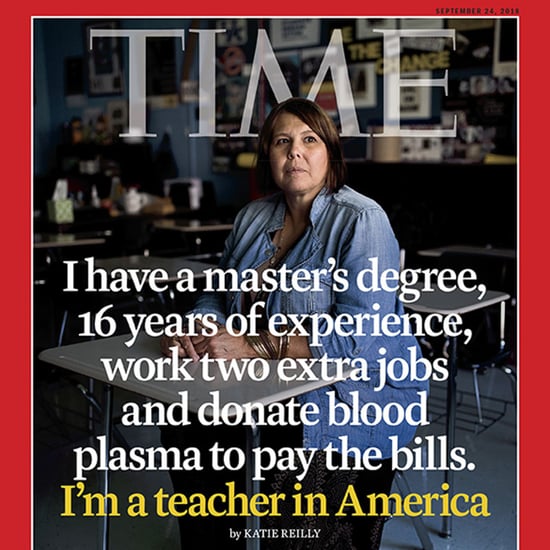
And then there are some people who have all the evidence right in front of them and still don’t see the full picture. Take the recent Time Magazine covers for example—you know, the ones with the photo of a teacher with the caption that reads, “I have a master’s degree, 16 years of work experience, work two extra jobs and donate blood plasma to pay the bills. I am a teacher in America.”  Or “I have 20 years of experience, but I can’t afford to fix my car, see a doctor for headaches, or save for my child’s future. I am a teacher in America.”

The article goes into the reality of being a teacher in America from working long hours, losing benefits, paying for your own supplies, losing control of the curriculum and no help in classroom management.  As the wife and the sister of public-school teachers, I see this up close every day so it’s no big surprise. But I guess there are people out there who just don’t see the truth of our education system or feel the need to blame it on others rather than work to fix the problems. So, you have to put it on the front of a major magazine to try to get some people’s attentions; but even then, will it make a difference?

I’ve never understood how some people can have all the facts right in front of them and still not see the bigger picture; not see that they are not treating people the way they should. But, I know I can be guilty of not seeing the truth sometimes.

What if we all got to write our own Time Magazine covers? Would anyone be surprised to read them? Sure, most of us could probably write something about how we are overworked, underpaid, and forced to work multiple jobs to make ends meet—I know I am.

But what would people write about us? What would your kids write about you? What would your husband write? Your friends? Maybe it would go something like this: “I work hard all week and my wife only points out the fact that I didn’t make the bed, or I was too hard on the kids.”


Or, “I work hard, I’m honest, I do my homework and my mother is still never happy with my grades or my friends.”

But these are just what we could guess—sometimes the reality of what others think about you is so far removed from your own reality you can’t imagine they would have something negative to say about you.

But even though we know the truth about how we are treated, we are mostly afraid to write those headlines and be honest about how we are treated—whether we are mistreated at work or in our personal lives by people who are supposed to love and accept us.

Sometimes it’s hard to admit you’ve allowed someone to treat you so poorly and sometimes we don’t know how to get out of that toxic relationship. Sometimes it’s hard to write those headlines, but it’s probably even harder to read those headlines and know in your heart that it’s about you--and it’s true.

You don’t always need to experience something to know it’s true—you don’t have to be a teacher to know they are mistreated, and you don’t have to hear someone tell you that a slumber party at work is a really bad idea.

But sometimes you need to write that headline and let certain people in your life know they are mistreating you. Or write that headline to claim your shame or write that headline to own the circumstances in your life and know you are not alone. Maybe if we all spent a little more time reading those headlines instead of writing stories we feel are true, we’d be a little closer to reality and little more accepting of others. But in the end, it doesn't really matter unless you're willing to accept the truth that's be put in front of you. 


Sunday, September 9, 2018

Broken plates, missing pieces and revisting old feelings


Ok, so far so  good keeping with my new writing schedule for the second week.

It’s funny because I’ve been going through some writing I did about 4 or 5 years ago that I felt was really good, and now I’m thinking it’s crap. I guess that’s normal. I think we all do that in some ways.

Like when I look back on old photos of myself and I remember feeling so fat or unattractive when the photo was taken and now I think, hey, I looked pretty good—sometimes vice versa. Or when I think about getting really mad at someone--then I try to remember what I was even mad about. But at the time it seemed like a big deal. I guess we all have those stories.

Hindsight is 20/20? Maybe? Or maybe hindsight on top of more hindsight is what gets us closer to 20/20.


I’ve looked over some of my old blog posts and realize some of them were very rant-like. I had so much anger in those days—and rightfully so. I look back on those days and wonder how I kept everything together, but I also look back and remember how I thought I had moved past my anger and was healing. Sometimes I wonder if I did lose a piece of me? Something small or maybe even lots of pieces?

I look at my daughter now—she’s so fierce and seems to have the world at her feet. She’s much fiercer than I was at her age. But looking back, I know I had that sort of confidence, I just lost it many years ago and have never really gotten it back. I had glimpses of it from time to time but never the real thing. Never that sense of “I know without a doubt that I am 100 percent right about…”

It’s like as if I was this perfectly intricate beautiful plate when I was a little girl and slowly, over the years that plate was chipped and bumped and eventually dropped and shattered and then put back together over the years with some rough edges and uneven patterns but never the same plate. But over time, some of that smoothness and delicate features have returned and some spots look completely different but somehow healed and strangely unique and beautiful. And now I can look back and wonder what I can do to make some more of those rough edges smooth again—and not so angry or hurt or insecure.

So maybe some of those small pieces are missing now, but it doesn’t really matter if the plate is back together--and I know those pieces had to go away in order to rebuild and get to where I am today.

Today I look at my daughter as she plans to head out to cover a story for her journalism class; camera in hand and press pass tucked into her back pocket and wonder what she will have to go through in life and what small pieces she will be missing when she’s my age. But I hope she can find a way to make peace with the hand she has been dealt and stay close to that confidence of knowing where she is heading and why.


Because in the end, it doesn’t matter that those small pieces are gone or that at some point all the pieces ended up on the floor in a scattered mess. What matters is how we chose to piece ourselves back to together again and what pieces we decided to keep or throw away or maybe even make better.

I know on some level, I had to be shattered into pieces. And on another level, I’ve had to be constantly bumped and chipped again in order to rearrange those pieces to let go of the anger and the hurt and find my confidence again—and push myself to do the things I know I need to do in order to not only fix my pieces but to heal the relationships around me—even the ones that I wish I never had.